

About the condition
The anterior cruciate ligament (ACL) runs through the centre of the knee and helps control rotation and forward movement of the shin bone. It can be injured during sport when the knee twists, lands awkwardly or stops suddenly, and it may also follow a direct blow.
Some ACL injuries are treated with physiotherapy alone, while others need reconstruction surgery. In both cases, rehabilitation is essential: the knee must regain movement, strength, balance and control before it can cope with sport and daily activity again.
Common symptoms to look out for
- A sudden pop or giving-way sensation at the time of injury
- Knee swelling that develops within hours
- Pain and a feeling of instability when walking or turning
- Difficulty bearing weight on the affected leg
- Reduced knee movement and stiffness
- A sense that the knee may give way during sport
This information is general in nature. It is not a diagnosis, and individual situations vary. A physiotherapist can assess your specific condition.
How physiotherapy may help
Treatment is based on assessment findings and your goals. Approaches commonly used include:
Assessment
Your physiotherapist examines knee movement, swelling, strength and stability, and checks for other injuries that may need medical review or imaging.
Swelling and pain management
Early advice on activity, elevation and movement helps control swelling and discomfort after the injury or surgery.
Mobility exercises
Graded movement work aims to restore full knee bending and straightening without stressing the healing ligament.
Strengthening
Progressive strengthening of the thigh, hamstring and hip muscles rebuilds support around the knee.
Balance and control training
Balance, landing and change-of-direction drills retrain the knee to control movement and reduce the risk of re-injury.
Return-to-sport rehabilitation
A staged programme, guided by your surgeon's instructions where relevant, prepares you to return to training and sport at a safe pace.
Physiotherapy aims to improve movement and function, but results vary from person to person. No specific outcome can be guaranteed.
Who may benefit
- Athletes and active people with an ACL injury
- Patients recovering after ACL reconstruction surgery
- People with knee instability or repeated giving-way
- Those returning to sport after a knee ligament injury
- Anyone whose knee injury is limiting walking or daily activity
What to expect during treatment
- 1
Initial assessment
Your physiotherapist asks about your symptoms, medical history and daily activities, then examines movement, strength, and how your condition affects you.
- 2
Identifying movement limitations
Your physiotherapist measures knee movement, strength and stability to identify what needs to be addressed first in your rehabilitation.
- 3
Personalised treatment plan
You receive a plan built around your condition and goals, with realistic expectations and a clear idea of what will be done at each session.
- 4
Exercise and rehabilitation
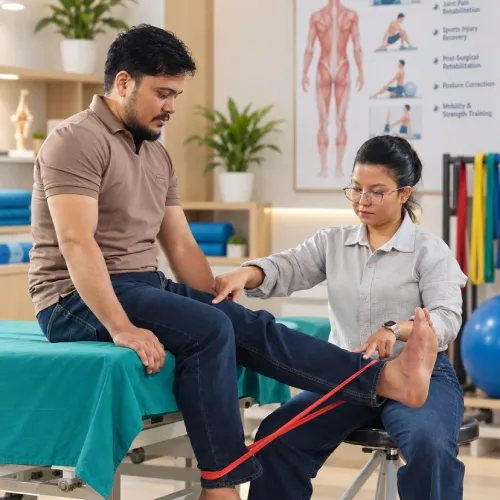
Treatment combines guided exercises, hands-on techniques where appropriate, and education about posture and movement you can continue at home.
- 5
Progress monitoring
Your physiotherapist reviews your progress regularly and adjusts the plan as your movement, strength and confidence improve.
Frequently asked questions
Can physiotherapy help an ACL injury?+
Physiotherapy is central to ACL care, whether the injury is treated conservatively or with surgery. Exercise-based rehabilitation aims to restore movement, strength and stability, though recovery time varies and some injuries need surgical review.
Do all ACL injuries need surgery?+
No. Some people manage well with rehabilitation alone, depending on their knee, activity level and goals. Others need reconstruction surgery. Your doctor or physiotherapist can discuss which approach suits you.
When should ACL rehabilitation start?+
Rehabilitation usually starts soon after the injury or surgery, once swelling and pain allow. If you have had surgery, follow your surgeon's instructions on movement and weight-bearing.
How long does ACL rehabilitation take?+
Return to daily activity often takes weeks to a few months, while a full return to sport commonly takes six to twelve months or longer. Your physiotherapist will set staged goals with you.
Can I return to sport after an ACL injury?+
Many people return to sport after completing rehabilitation. A gradual, criteria-based programme helps rebuild strength and control first, which reduces the risk of re-injury.
What should I bring to my first appointment?+
Bring any MRI or X-ray reports, surgery notes and your surgeon's instructions if you have them. Wear comfortable clothing, such as shorts, so your knee can be examined easily.
Related services
Knee Pain Physiotherapy
Rehabilitation for knee pain from arthritis, injury or post-surgical recovery, focused on strength and mobility.
Sports Injury Physiotherapy
Assessment and progressive rehabilitation for sprains, strains, muscle and joint injuries, with return-to-sport planning.
Post-Surgery Physiotherapy
Guided rehabilitation after joint replacement, fracture, ligament or shoulder surgery to rebuild mobility and strength.
Need Physiotherapy in Nepalgunj?
Book an Appointment with Nepalgunj Physiotherapy Clinic for ACL Physiotherapy. Call or message us to discuss an assessment and a treatment plan suited to your needs.
Phone9858023674
LocationGaneshman Chowk, Nepalgunj 10, Banke, Lumbini Province, Nepal